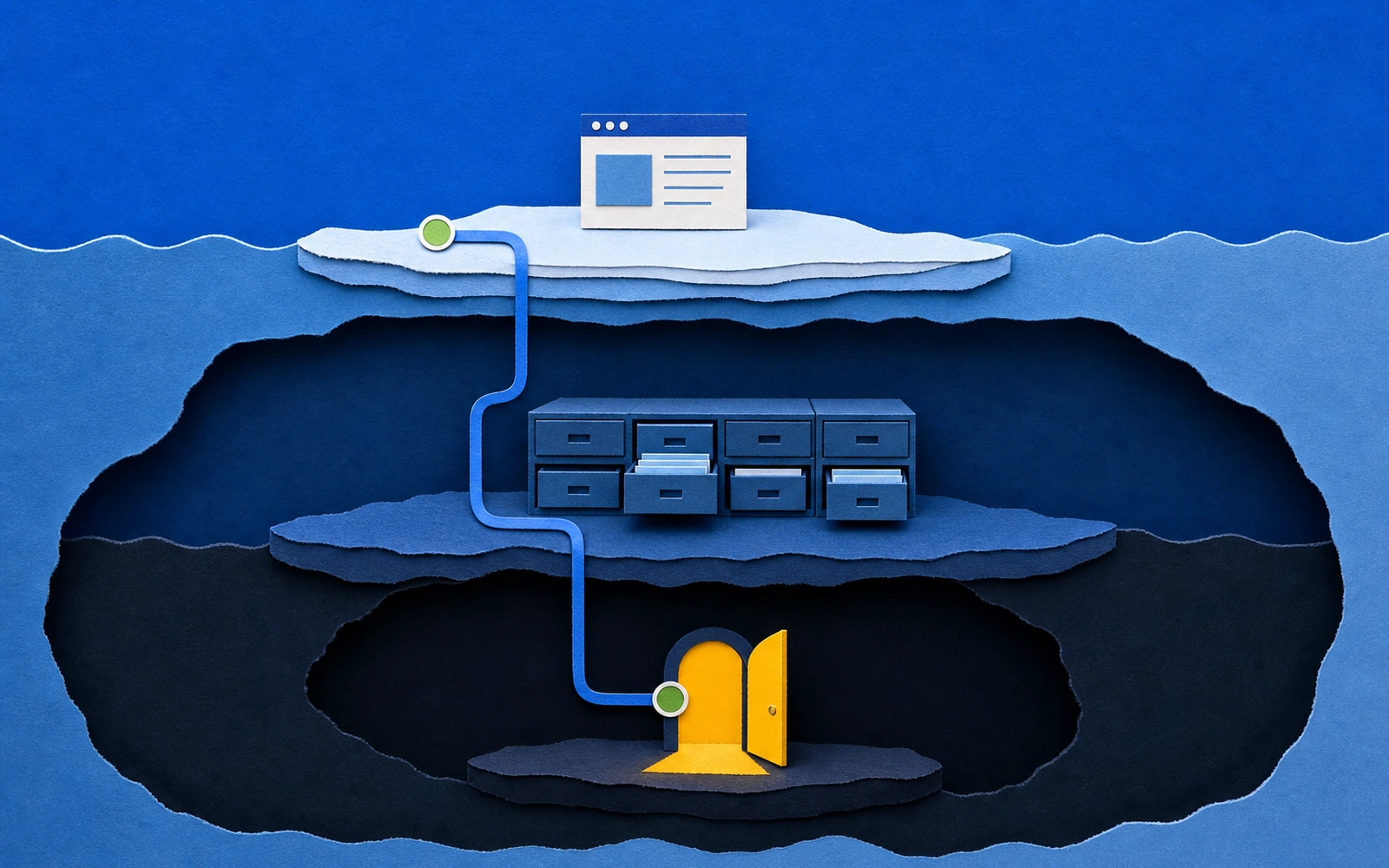
The phrases surface web, deep web, and dark web are often presented as three descending levels of danger. That framing is memorable, but it is technically loose and usually unhelpful. Most of the deep web is ordinary private or unindexed material: an account dashboard, a medical portal, a paid research database, or a page that a search engine has not discovered. The dark web is a narrower idea involving networks or services that require a particular access method. Neither label tells you whether the people, content, or activity involved are lawful, trustworthy, or safe.
A better vocabulary starts with two separate questions. First, can a conventional search engine discover and index this resource? Second, what network and software are required to reach it? Those questions explain more than an iceberg graphic ever can.
The three terms describe different properties
The surface web is the portion of the public web that search engines can crawl and include in their indexes. A page does not become surface-web content merely because it uses an ordinary .com address, and appearing in search results is not guaranteed. Crawlers generally need to discover and fetch a URL to index its content, but a blocked URL can still appear in results based on links even when the crawler cannot read the page. A noindex rule works only when the crawler is allowed to fetch it. A newly published page, an orphaned page with no incoming links, or a page carrying a noindex directive may use an ordinary public URL while remaining outside major search indexes.
The deep web is an umbrella term for web content that conventional search engines do not index. Some of it sits behind authentication or payment. Some is generated only after a database query. Some is deliberately excluded from indexing, and some is simply obscure. Your private webmail, a company intranet, an online banking session, and a draft in a content-management system are familiar examples. You normally reach these resources with an ordinary browser over the ordinary Internet; authorization, obscurity, or crawler behavior—not a special anonymity network—keeps them out of public search results.
The dark web generally refers to web services available through a darknet or privacy overlay and reached with network-aware software, such as Tor onion services or sites inside I2P. These systems use their own routing and naming mechanisms. Tor’s .onion names are special-use names that Tor-aware software resolves without ordinary DNS. I2P destinations can be reached by cryptographic addresses or by human-readable names stored through I2P’s local naming and address-book system. A normal browser with a normal direct connection does not know how to reach either one.
People commonly describe the dark web as a subset of the deep web because its pages are not part of ordinary search indexes. That is a useful introductory shortcut, not a law of network architecture. Deep web describes indexing or access conditions on the web; darknet describes a network; and dark web describes web services available through such networks. Keeping those dimensions separate prevents a great deal of confusion.
Surface and deep content use the same ordinary web more often than not
Search visibility is a publishing choice only up to a point. A publisher can provide crawlable links, useful metadata, a sitemap, and permission to index. A publisher can also request exclusion with a robots meta directive. Search engines still make their own indexing decisions, and only cooperative crawlers honor exclusion instructions. Authentication is the stronger boundary for private material: a noindex tag asks a crawler not to list a page; it does not stop a person who already has the URL from opening it.
This distinction matters because “not on Google” is not the same as secret. Links travel through messages, referrer data, browser history, server logs, archives, and other pages. A URL may be absent from search today and indexed tomorrow. Conversely, a public page may remain difficult to find even though anyone can open it. Discovery and access control are different systems.
The deep web is therefore not a special destination that someone enters. People use it continuously as they sign in, submit forms, retrieve records, or view content tailored to an account. Calling all of that material “dark” obscures the normal security practices it needs: sound authentication, limited permissions, secure sessions, careful data retention, and timely software maintenance.
The surface/deep boundary can also change without the content moving. Remove a login, add crawlable links, or change an indexing directive and a page may become discoverable. Put the same page behind an account and it becomes deep-web content again. The underlying server can remain exactly where it was.
The dark web changes the route, not the rules of reality
A Tor onion service and an I2P site are reached through overlay networks running on top of Internet connectivity. The overlay changes how clients find and connect to the service. In Tor, a client and onion service establish circuits and meet through introduction and rendezvous mechanisms without using the service’s IP address as the public destination. In I2P, applications communicate through cryptographic destinations and inbound and outbound tunnels maintained by I2P routers.
Those designs can reduce direct exposure and support privacy-preserving publication, but the network layer cannot correct every mistake above it. An application can still reveal names in page content, load third-party resources, retain unnecessary logs, expose administrative interfaces, reuse identifying accounts, or publish distinctive files. A service can also be unreliable, malicious, compromised, or illegal. Privacy technology is not a credibility rating and does not create immunity from law or policy.
Likewise, a darknet is not synonymous with a criminal market. Privacy networks support journalism, research, censorship circumvention, private collaboration, software distribution, community services, and ordinary experimentation. The same networks can be misused, just as ordinary Internet services can be misused. Describing the access technology accurately makes it possible to discuss both legitimate value and abuse without turning either into a stereotype.
Publishers should also distinguish a native hidden service from a gateway or proxy. A gateway may make hidden-network content viewable from a conventional browser, but the gateway becomes part of the connection and may not provide the privacy properties a native Tor or I2P client provides. It can broaden discovery or convenience; it does not magically transfer every protection of the underlying network to the visitor.
Practical Takeaway
When evaluating a site, ask four concrete questions instead of assigning it a dramatic layer:
- How is it addressed? Is it an ordinary DNS name, a Tor
.onionaddress, an I2P destination, or a human-readable I2P address-book name? - What software and route reach it? Does it use a conventional browser connection, Tor, I2P, or a third-party gateway?
- What controls access? Is the resource public to anyone who knows the address, protected by login, or restricted with network-level client authorization?
- How is it discovered? Through a public search engine, direct sharing, a directory, an address-book subscription, a link from another site, or an opt-in bridge?
For publishers, choose access, visibility, and authorization deliberately. A hidden-service address can be publicly promoted; an ordinary website can be private behind authentication. Search exclusion is not access control, and a special network is not a substitute for secure application design. That clarity is especially valuable when explaining a privacy network to newcomers who may otherwise confuse an unindexed page with a hidden service. It also helps teams decide where authentication belongs, which software readers require, how addresses should be verified, and which claims a publisher can support with evidence. Precise terms lead to better threat models, clearer audience expectations, and fewer false promises.