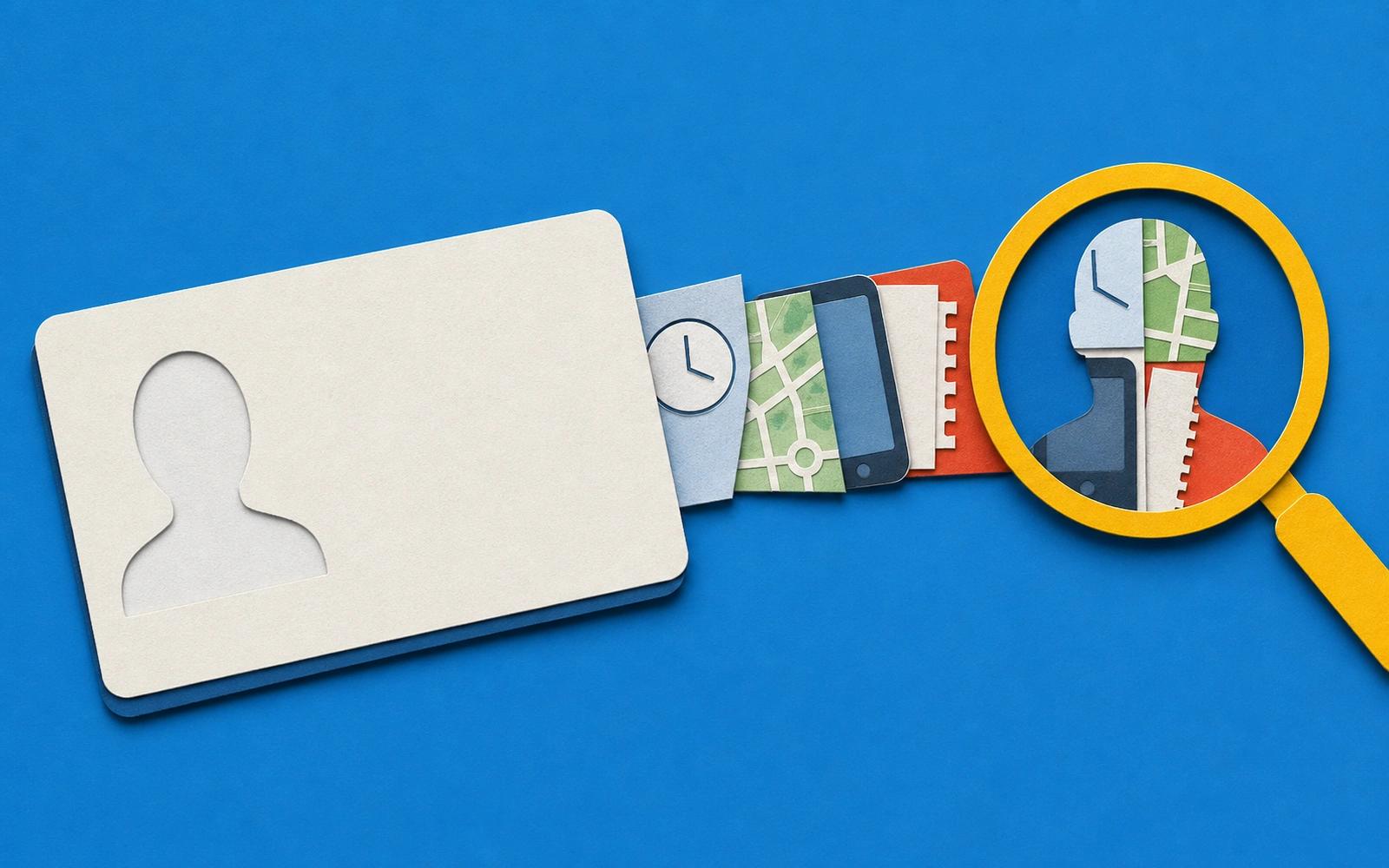
A publisher can remove a name from an article and still disclose who created it, where it was created, which device handled it, when it moved through a workflow, or which other accounts belong to the same person. Those clues are metadata: information about a file, message, request, account, or pattern rather than the main content a reader thinks they are receiving.
Metadata is not automatically malicious. Timestamps help editors coordinate, logs help operators repair outages, and document properties help teams manage revisions. The privacy problem appears when information collected for one purpose travels into another context or is retained longer than the purpose requires. The right response is not to promise a metadata-free publication. It is to identify the metadata surfaces, minimize what is unnecessary, and verify the public result.
Metadata exists at more than one layer
File metadata is the most familiar layer. Photographs may contain EXIF fields such as capture time, camera model, orientation, and sometimes coordinates. Office documents and PDFs may contain author or organization fields, software versions, creation and modification times, comments, hidden layers, revision information, embedded media, or an earlier filename. Audio and video formats carry their own tags. The exact fields depend on the device, application, export path, and format.
Content-management metadata lives outside the file. A publishing platform may record the uploader, draft author, revision history, scheduled time, internal notes, IP address, session, or media-library filename. A generic public byline does not necessarily change those private records. That separation can be useful for accountability, but access and retention should be intentional. Private provenance should never drift automatically into public templates, feeds, structured data, attachment pages, or notification emails.
Network and server metadata includes request times, source addresses visible at a particular hop, routes, user agents, referrers, error details, and account identifiers. Tor or I2P changes parts of that path, but the application, gateway, host, and monitoring systems may still produce records. OWASP’s logging guidance captures the central tradeoff: logs are important for security and operations, yet session tokens, secrets, sensitive personal data, and other high-risk values generally should not be written directly to them.
Browser and device characteristics can become a fingerprint. Screen size, timezone, language, fonts, codecs, browser version, graphics behavior, and settings may be combined to distinguish one browser from others. Tor Browser’s strategy is not to make every property disappear; it aims to reduce identifying differences among its users. Customizing it or mixing the same identity across ordinary and privacy-focused browsing contexts can undermine that goal.
Behavioral and semantic clues are part of the picture too. Reused usernames, posting schedules, favorite phrases, uncommon spelling, repeated examples, linked accounts, unique images, and simultaneous announcements can connect identities. These clues are not stored in a metadata field that a cleaning tool can delete. They are produced by the publication pattern itself.
Cleaning a file is a process, not a button
Begin by deciding what the public artifact needs to preserve. A photograph may need visible authorship or licensing information even if location and device details are removed. A research document may need citations and change history in the editorial archive but not in the downloadable public copy. Indiscriminate stripping can remove useful accessibility, rights, color, or provenance information along with sensitive fields.
Work from a retained source in a controlled editorial location and create a separate publication copy. Inspect the source with tools appropriate to the format. Remove or replace fields that conflict with the publication policy, flatten comments and tracked changes where appropriate, and export through a known path. Then inspect the exported copy again. Do not assume that changing a filename, taking a screenshot, printing to PDF, or uploading through a platform removed everything. Each transformation may remove some data, preserve other data, and add fresh timestamps or software identifiers.
Visual inspection matters as much as tag inspection. A reflection, street sign, window view, badge, document header, browser tab, notification, QR code, or distinctive crop can reveal more than EXIF. Redaction must remove underlying information rather than placing an easily removable shape above it. When a document is high-risk, consider whether it should be published as a file at all. A carefully rebuilt web page may expose less hidden state, though it still has application and server metadata.
Verify the downloaded public result, not only the local export. A content platform may transform images, generate alternate sizes, preserve originals, expose attachment pages, or place original filenames in URLs. Download every public variant that matters and inspect it as an outside reader would. Keep the private source and the sanitized publication copy clearly separated so a later editor does not upload the wrong one.
Minimize metadata across the workflow
A practical workflow begins before the file exists. Disable location tagging when it is unnecessary, avoid using a personal account for a separated publishing identity, and decide where originals may be stored. Use role-based editorial accounts rather than sharing credentials. Keep public byline fields distinct from private contributor records. Limit who can see identity data, and make final publication review a different step from ordinary copy editing.
At the application layer, inventory where identity can surface: author archives, media pages, RSS feeds, email notifications, REST responses, schema markup, revision views, analytics, backups, and support tools. A hidden field in the editor is not necessarily hidden everywhere. Test with a logged-out browser and inspect public page source and downloadable assets.
At the logging layer, write down why each event is recorded. Prefer event types and pseudonymous internal identifiers over raw secrets or unnecessary personal data. Protect log access, define retention, and verify disposal. Reducing logs to zero can make abuse investigation and incident response impossible; collecting everything can create a detailed surveillance dataset. The useful target is enough information for a defined operational purpose, with sensitive values excluded or protected.
Separate identities by workflow rather than by willpower. Distinct accounts, browser profiles, recovery channels, asset libraries, and editorial checklists reduce accidental cross-posting. Separation does not guarantee unlinkability—writing style, timing, third-party records, or legal process may still connect contexts—but it makes common mistakes less likely.
Finally, plan for corrections. If sensitive information is published, removing it from the current page may not remove copies, feeds, caches, notifications, mirrors, or earlier downloads. A response plan should identify the exposed artifact, rotate any compromised credentials or service identity, replace public copies, notify affected people when appropriate, and document what changed in the workflow.
Practical Takeaway
Create a prepublication metadata check with four columns: artifact, private data that may exist, public data that is required, and verification method. Apply it to images, office documents, PDFs, video, downloadable archives, and the web page itself. Assign a reviewer who did not create the source file.
For a typical article, verify the public byline and structured metadata; inspect featured and inline images; check filenames, alt text, captions, and attachment URLs; download the public derivatives; review the logged-out page and feed; and confirm that private contributor fields and editor notes are absent. Record the check without copying sensitive values into the checklist.
Use Start With a Threat Model, Not a Tool List to decide which metadata surfaces deserve priority. The guiding question is broader than Did we remove the author name? Ask instead: What information crosses from the private production context into the public one, and did we choose every part of that transfer?
Sources and Further Reading
- Tor Project: Onionsite Checklist, including file metadata and operator guidance
- UK Information Commissioner’s Office: Disclosing documents to the public securely
- MDN Web Docs: Browser fingerprinting
- OWASP: Logging Cheat Sheet
- Tor Project: Tor Browser Fingerprinting Protections
- Tor Project: Managing Identities and Preventing Linkability
- Invisible-Internet Docs: Private Contact Relay
- Invisible-Internet Docs: Operational Contact and Service Notices
- Invisible-Internet Docs: Tor Hidden Services